
Stove Flue Installation
Stove flue installation determines how well an appliance draws, how cleanly it burns, and whether it is safe to use at all. Get the specification right and the stove performs as designed; get it wrong and the problems show up as poor draw, tarring, smoke spillage, or reduced heat output. We carry out flue and chimney work across Ramsbottom and roughly thirty miles around, with over twenty-five years of experience. This page covers the main flue options and how the right one is chosen.
Why Flue Specification Determines Stove Performance
The flue is not an accessory to the appliance, it is half the system. Diameter, height, insulation, and the number of bends in the run all affect draw, and a flue that is undersized, oversized, or poorly routed will undermine an otherwise good stove.
Insulation matters particularly. A flue that cools too quickly on its way up produces condensation and tar deposits, which reduce efficiency and increase the fire risk within the flue itself. This is why insulated systems are specified where the run is exposed or external.
- Diameter matched to the appliance outlet and output
- Adequate height for reliable draw
- Insulation to prevent flue gases cooling excessively
- Bends minimised and set at compliant angles
- Termination positioned to current regulations
Chimney Stove Installation Using an Existing Chimney
Where a property already has a chimney, chimney stove installation usually involves lining it rather than using it as-is. Older chimneys were built for open fires, which produce a very different flue gas volume and temperature from a modern closed appliance, and an unlined chimney is frequently oversized for a stove.
Lining resolves that by creating a correctly sized, sealed route. It also addresses deterioration in older brickwork, where mortar joints may no longer be gas-tight.
Chimney condition is not always visible from inside the property. A camera survey or smoke test establishes whether the flue is continuous and gas-tight along its full height, which matters particularly in older properties where mortar joints may have deteriorated or where a chimney has been partially blocked during previous building work.
Twin Wall Flue Installation Where No Chimney Exists
Twin wall flue installation provides a compliant route where there is no usable chimney. The system consists of an inner liner and an outer casing with insulation between, which keeps flue gases hot enough to maintain draw through the full run.
The route can be taken internally through the building and out through the roof, or externally up an outside wall. Internal routes generally perform better because the flue stays warmer, but external routes are often simpler to install and less disruptive.
- Lining an existing chimney where one is present
- Twin wall systems where no chimney exists
- Internal or external routing depending on the property
- Insulated construction to maintain flue gas temperature
Flue Pipe Installation and Connection Detail
Flue pipe installation from the appliance outlet to the main flue system is a short run, but it is where a large share of problems originate. Connections have to be made with the correct jointing method for the pipe type, sealed properly, and supported so that no load is placed on the appliance outlet.
Access for sweeping also needs designing in at this stage. A flue that cannot be swept properly will not stay safe, regardless of how well it was installed.
Log Burner Flue Installation and Regulations
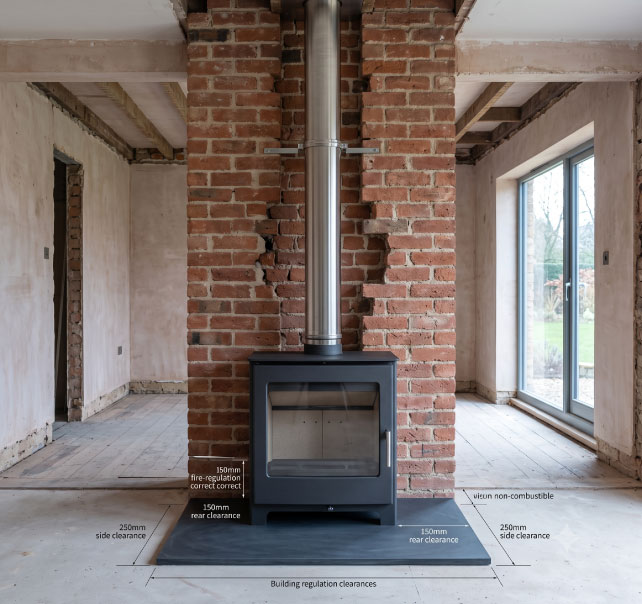
Log burner flue installation is governed by Building Regulations Part J, covering flue sizing, termination height and position, clearances to combustible materials, and access for inspection and cleaning. A HETAS-registered installer certifies the work against those requirements on completion.
Compliance is not paperwork for its own sake. Termination height affects draw and neighbour nuisance, clearances affect fire risk, and sweeping access affects long-term safety.
- Flue sizing and height set to Part J requirements
- Termination positioned correctly relative to roof and openings
- Clearances to combustible materials maintained throughout
- Sweeping and inspection access designed into the run
- Compliance certificate issued on completion
Wood Burner Flue Installation Surveys
Every wood burner flue installation starts with establishing what route the property allows. That is a survey question, not a phone question, because chimney condition and roof construction determine the options available.
Call 01706 822208 or 07787 858585 to arrange a survey covering flue options, lining requirements, and what your installation would realistically involve.
Where a flue is being replaced rather than installed from new, the survey also establishes whether the existing terminal, pot, and flashing are serviceable or need replacing at the same time. Doing that work together avoids returning to the roof twice.